Falsely Accused of Using AI? Here’s Exactly What to Do
You receive an email from your professor, saying that your essay has been flagged as being AI-generated. Your heart starts beating faster after spending hours researching, reading, and writing your essay. You start to worry about your grade, academic record, and future.
If you have been falsely accused of using AI, you may feel frustrated, confused, and anxious. This is completely normal. But it is really important to stay calm and use actual evidence to help explain your side of the story.
This guide will show you how to protect your work, gather helpful evidence, ask your professor questions, and appeal an academic integrity decision. This guide is for students who have actually written their own work. If you have used AI to write your work and handed it in as your own, DO NOT produce fake evidence or a story. Follow your school’s procedure and be honest about what happened.
⚠️ Academic integrity note: This guide is for students who did their own work and were flagged by mistake. It shows how to defend yourself with evidence — not how to hide AI use. If you did use AI against your course rules, the honest move is to say so and follow your institution’s process. This is general information only, not legal advice — your college’s academic integrity policy governs.
5 Steps if Falsely Accused of Using AI
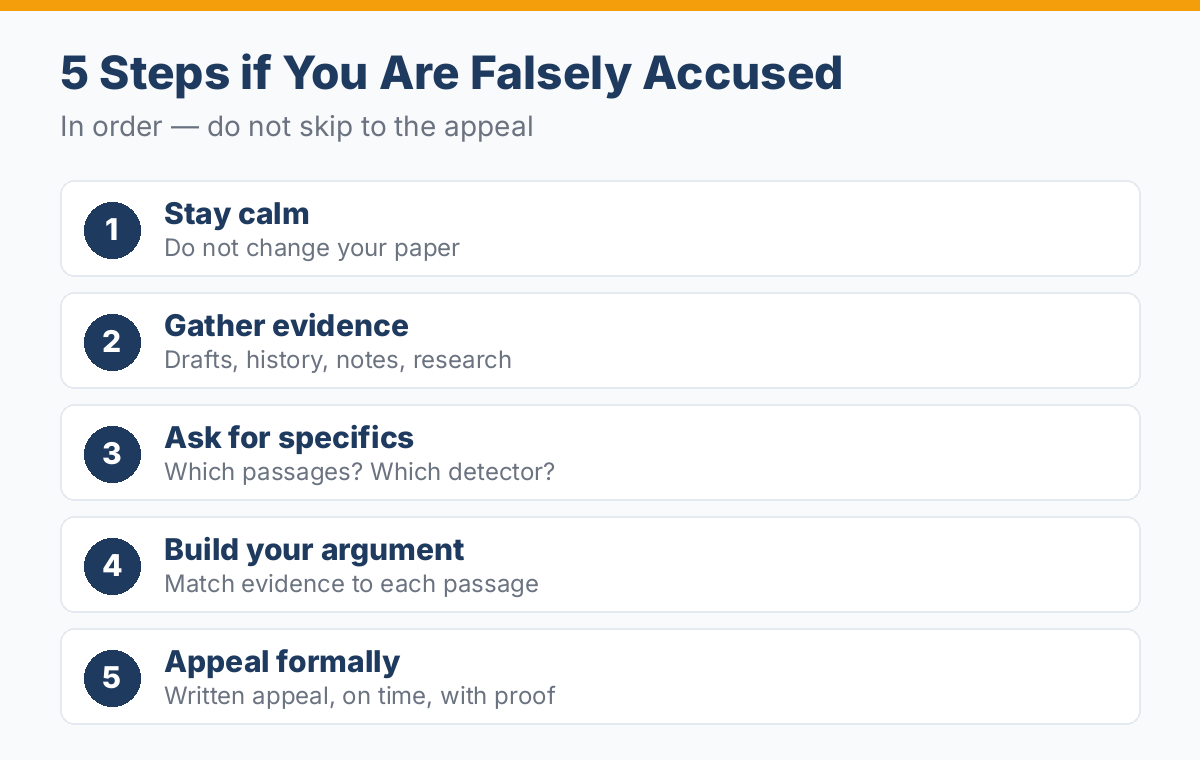
Here are five important steps that you should follow if your college professor falsely accuses you of using AI.
Step 1 – Stay Calm and Do Not Change Your Paper
Keep your original work safe. If you want to avoid the allegations by editing your paper, do not!
Editing your original document could cause issues proving how your paper was completed. This can also raise questions as to why the text was edited as a result of your professor’s concerns.
Do not:
- Edit any parts of the text you have been accused of.
- Delete any of your drafts, notes, or research.
- Clear any browser history or messages related to the assignment.
- Create any notes with a past date or edit the timestamps.
- Repeat any tests that can cause changes to your original files.
Make copies of your current work. Save screenshots and download any files you can. Store them somewhere safe away from your school account. Do not alter the original files.
Time is an issue here. You want to make sure you have copies of your version history, temporary files, and account details. If you are concerned about losing access, contact your school’s IT department to find out how to keep your records.
Remember, the detector flagging your work is just an allegation. Many colleges have a process in place to help students provide explanations for their work. Check your student handbook and follow the guidance given to you.
Step 2 – Gather Your Evidence
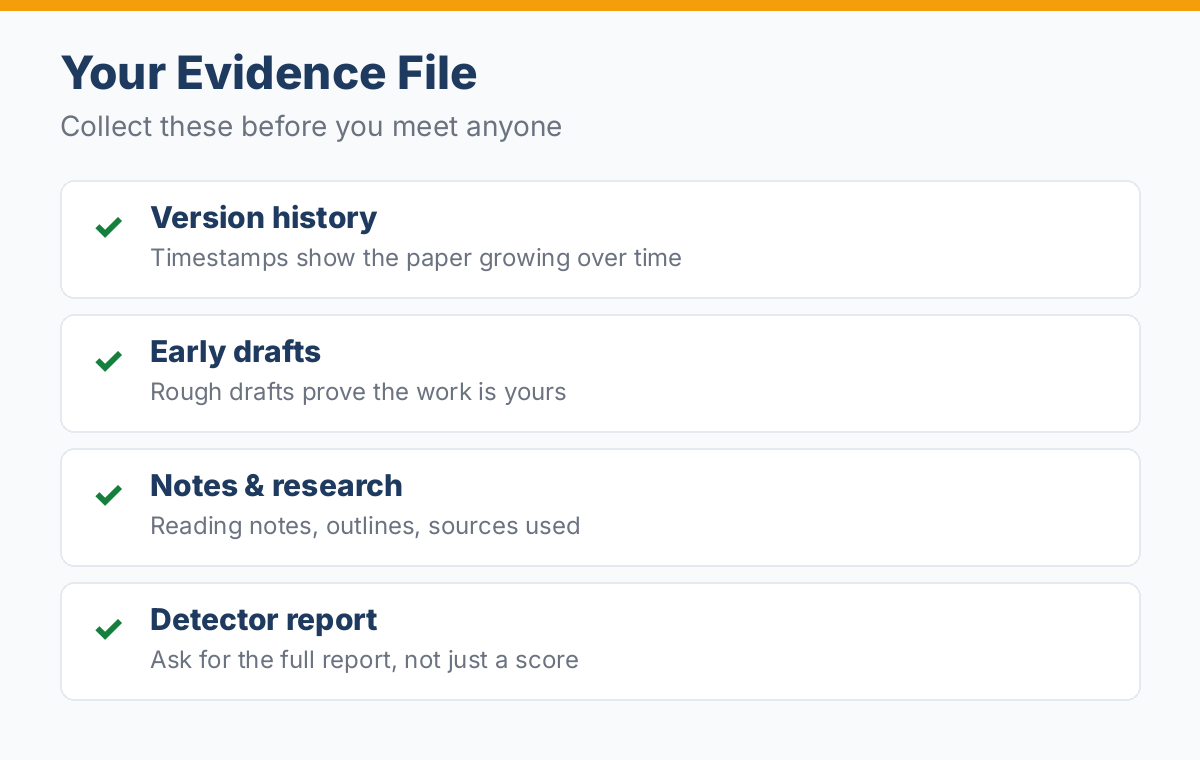
Your writing process can help here if they accuse you of using AI.
Gather evidence to show how you came up with your ideas, researched, and wrote your paper. The best evidence will often show a clear writing process.
| Evidence | Where To Find It | Why It Helps |
| Document version history | Google Docs or Microsoft Word | Shows changes made while the paper was written |
| Earlier drafts and outlines | Your computer, cloud storage, or notebooks | Shows how your ideas developed |
| Research trail | Browser history, bookmarks, and library accounts | Helps show which sources you reviewed |
| File timestamps | Original files and file details | May support the timeline of your work |
| Past writing samples | Earlier graded assignments | Allows comparison with your usual writing style |
| Messages about the assignment | Emails and relevant charts | May show when you discussed ideas or research |
Document Version History
In Google Docs, look for the version history of the document. For Word, you should check what version history there is for your document and also your storage account.
Look for previous versions that include your title, plan, paragraphs, and changes you made. Save any records you can find. Don’t rely on screenshots to prove anything; use them along with other evidence.
Notes and Research
Save any notes you may have written by hand, any downloads you have saved, plans, and links to articles you have used. If you have looked up information in your college library, then your search history may be useful to show how you researched.
Ensure you save any previous assignments you have done. This can help show what your usual writing style is like. However, differences in writing will not necessarily mean misconduct has occurred, as your professor may compare the documents.
Save any emails or messages relating to the assignment. Ensure you use real evidence.
Make sure you save copies now. Find a location where you can still access your evidence even if you lose access to your school account. Ensure that you don’t change or edit your original evidence to make your case stronger.
Step 3 – Ask for Specifics
Don’t assume why your paper was flagged. Ask your professor to give you specific information.
Be polite and straightforward. Remember, you are not blaming your instructor. You are simply asking for more details so you can understand the issue and respond properly.
Ask them questions about:
- What detection tool did they use?
- Can they send you a copy of the detection report?
- What score did you get? What parts were highlighted as AI-generated?
- What is the school’s trigger score or guidelines?
- What is the written academic integrity policy?
- What happens next? When do you need to respond?
Here is an example of an email you can edit:
Subject: Requesting details about my assignment
Dear Professor [Last Name],
I’m writing to ask about the concern raised regarding my assignment. I wrote this paper myself and would like to know why there is a concern.
Can you please send me a copy of the AI detection report, which sections were flagged, and the academic integrity policy that is relevant to this case? Also, are there any next steps and deadlines I need to be aware of?
I can also send you copies of my drafts, track changes, research notes, and other evidence to show how I developed my work. I am also happy to talk about my research and how I wrote my assignment.
Thank you for your time. I look forward to finding out why there is a concern and responding via the correct channels.
Kind regards,
[Your Name]
[Course Name/Number]
Try to keep all your responses via email. If you have a meeting, then send a brief summary email to make a record of what was discussed.
Step 4 – Build Your Argument
AI detection tools sometimes flag human-written texts. Using simple language, short sentences, and repetitive language can make your writing seem like it was written by AI. However, many students will naturally write like this.
What does the research say?
A study conducted by Weixin Liang and others in 2023 found that non-native English writers often got flagged by AI detection tools.
Turnitin also admits that its AI detection tool can be inaccurate, and they advise schools not to rely solely on an AI score. This shows that you cannot prove a student has used AI just by looking at their AI score.
Who could be affected?
- Students who have used simple language
- Essays with repetitive language
- Lab reports with set formats
- Short and simple sentences
None of these styles of writing mean that they have used AI.
How to build your case?
If you have been falsely accused of using AI, you can:
Show your work – Show your drafts, notes, research, and history.
Ask about the AI report – Ask what parts of your work were flagged. Explain that AI detection tools can be inaccurate.
Talk about your paper – Explain your ideas, sources, and how you completed your assignment.
You can use StudyAidHub to find useful resources regarding academic writing.
Remember that an AI detection score is just a warning sign. Your writing process and evidence are more important.
Step 5 – The Formal Appeal
If the allegation continues after your initial response, you may need to make a formal appeal or go through an academic integrity process.
Check your student handbook and your college’s academic integrity office website to find out what process you have to follow. This will include information on how to respond to the allegation, provide evidence and any appeals and deadlines.
Different colleges will have different names for these processes. You should check the written policy of your school.
Common Stages of an Academic Integrity Appeal
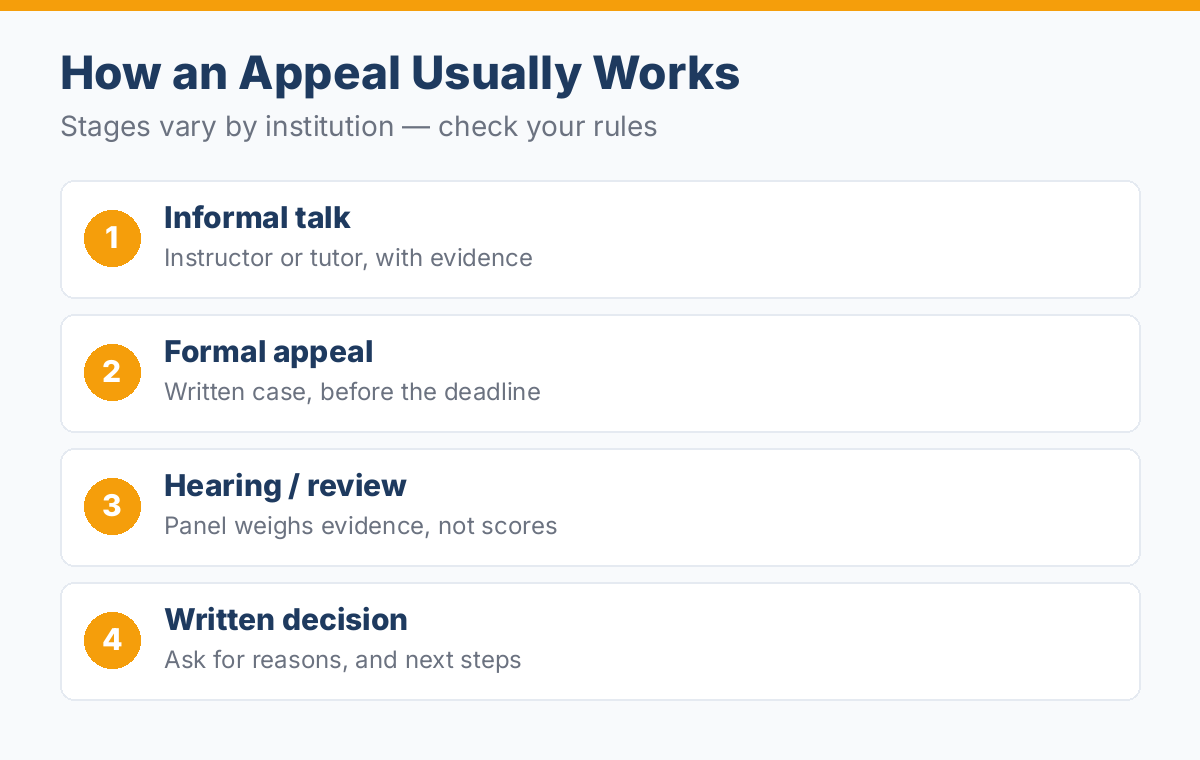
| Stage | What Happens | What To Bring |
| Written notice | You receive details of the concern or decision | The notice and relevant course policy |
| Evidence submission | You provide your explanation and supporting records | Drafts, version history, notes, and research records |
| Hearing or review | A professor, committee, or academic office reviews the case | Your evidence, timeline, and answers to questions |
| Decision | The school communicates its decision | A copy of the decision and any instructions for further review |
This table describes a general pattern. Your college may use different stages or names.
Check the Deadline
Some schools and institutions will allow you a limited number of working days to respond or appeal.
Do not guess how much time you have. Check your school’s rules, read the notice carefully, and contact the right office to confirm the deadline.
If the notice is unclear, ask to have this confirmed in writing. If you need more time to gather evidence, ask if you are able to get an extension.
What could happen?
Depending on your school’s policy and the evidence, you may have the allegation dropped, your grade reinstated, or a reduced penalty.
If your appeal against the AI is rejected by the school or college, read the decision carefully. Check whether another appeal is permitted and whether it must be based on new evidence, a procedural error, or another specific reason.
Keep copies of all notices, submissions, and decisions. If the consequences are serious, consider contacting your student advocate, student ombuds office, or a qualified adviser who understands your institution’s process.
How to Protect Yourself Next Time
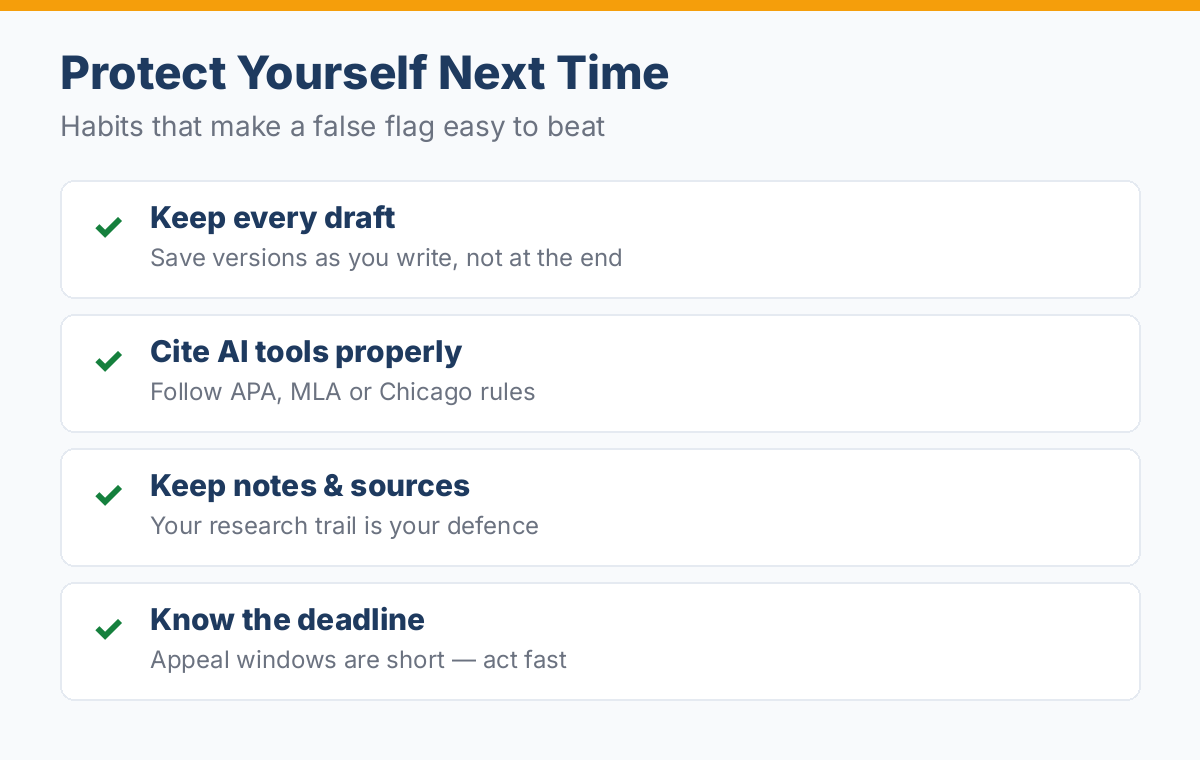
While you cannot control the outcome of your detectors, there are some easy ways to get into it to help you.
Use a document with version history: Google Docs and Microsoft Word allow you to keep previous versions, as long as they are turned on.
Save your outlines and notes: Keep them until you have received your final grade and any review period.
Save drafts with dates: This will help you keep track of your earlier drafts and later changes.
Save your research: Keep track of where you found your resources, your library searches, and notes about key information.
Check the AI policy for your course: Make sure you know which tools are allowed and save a copy.
Try not to write your whole assignment in a text box that does not save your progress. Instead, use a document that keeps a record of your changes. This can help you explain your writing process if your teacher ever has questions.
One habit that prevents many false flags is citing AI tools properly whenever you do use them — see our guides on how to cite AI in APA format, how to cite AI in MLA format, and how to cite AI in Chicago style.
Last verified: October 26, 2026.
FAQs:
1. Can I prove I didn’t use AI by showing a score on an AI detector?
No. Turnitin has said on their website that their models can sometimes give incorrect results and should not be used as a stand-alone piece of evidence to take action against a student. You should share any evidence with your professor/college and follow the academic integrity policy they have in place.
2. What is the best evidence to show that I completed the work myself?
Having clear document history can be useful to show how your work was created. This can include having previous versions, plans, research notes, source tracking, and writing examples. There is not one piece that will guarantee an outcome, but you should present real evidence to back up your claims.
3. Should I use an alternative detector?
Using multiple detectors may result in different results but will not prove who wrote the work. You should never change your original text to reduce the score. However, ensure you keep your files and ask the school for their report. Focus on presenting real evidence and follow your instructor’s guidelines.
4. How long do I have to appeal my academic integrity issue?
This depends on what your college has decided. Some schools have a short timeframe for responses. You should check your letter and student handbook immediately. If you are unsure about the timescale, then you should write to the correct academic office.
5. What should I do if my appeal is denied?
Ask for the decision in writing, including the reasons and the evidence that was considered. Then check your institution’s rules for the next review stage and its deadline — most processes have one further step, and it is usually time-limited. Take your full evidence file to that review, and ask your student support service or students’ union for help preparing it. Do not start a new appeal on the same grounds without new evidence or a procedural reason, as most institutions will not reopen a decided case.
Final Words:
If you have been falsely accused of using AI, then you should do the following. Firstly, make sure to keep a copy of your original documents. Then collect any evidence you have. Ask for written details of what they are accusing you of. Create an honest explanation and use the official appeal process. There have been many documented issues with AI detection software. Colleges have processes in place to investigate academic integrity issues. Just because you have been flagged by an AI detector does not mean you will win your case. However, having real evidence will help you create an explanation. Moving forward, keep dated drafts, save your research notes, and ensure you know the AI policies for your course.
✍️ About the StudyAidHub Team
The StudyAidHub team hands-on tests AI tools for students — every guide is based on real testing and verified against official sources, so you get advice you can actually trust. Learn more about how we test →