Learn How to Cite AI in Chicago Style (18th Edition) – Rules & Examples
Your professor wants you to use Chicago style, but the guides you’re finding only explain how to cite sources in APA or MLA. Now you’ve used ChatGPT, Claude, or Gemini, and you want to make sure you’re giving proper credit.
This guide shows you how to cite AI in Chicago style with examples that you can adapt for your own paper. We’ll discuss where to place your footnote or endnote, what information to include, and whether a bibliography entry is required. Generally, a citation to an AI chat should be treated similarly to a website or a book, depending on the context of its use, with the main difference that other researchers may not be able to access your particular conversation. The present guide is based on the Chicago Manual of Style, 18th edition (2024).
Academic Integrity Note: A proper citation does not allow permission to use AI when it is prohibited by your course policies. Always follow your instructor‘s guidelines first.
⚠️ Academic integrity note: Chicago style requires you to credit any AI tool you use — including the prompt you gave it and the date of the response. Many instructors also have their own AI policies, so check your course rules before you submit.
How to Cite AI in Chicago Style
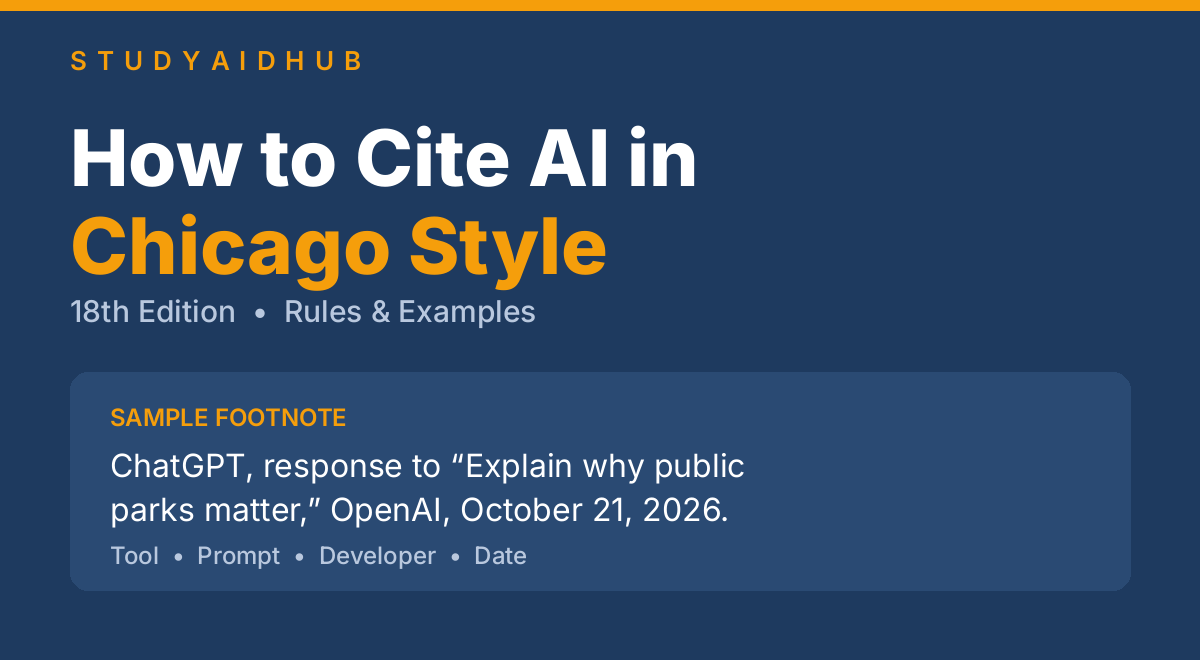
If you use text generated by an AI on your assignment, you have to credit the AI for creating it. In Chicago style, you have to use a footnote to add the name of the tool, its developer, and the date when you decided to generate the response. You also have to mention what you asked the AI in case it is not clear in your paper. Most often, no bibliography entry is needed for responses generated by AI.
Sample footnote:
- ChatGPT, response to “Explain why public parks matter,” OpenAI, October 21, 2026, URL.
Replace the sample date, prompt, and “URL” with your own details.
Chicago Has Two Systems – Which One Does Your Course Use?
Chicago style offers two basic ways to cite research in your paper. The first is Notes and Bibliography, while the second is Author–Date.
Notes and Bibliography uses small numbers indicating notes either at the bottom of the page (footnotes) or at the end of the work (endnotes). This method is usually used in history, literature, and other humanities courses. A note could be used to identify an AI generator and indicate the methods used to create it.
The Author-Date method uses brief citations within the text, typically in parentheses. A reference list provides the required detailed information about each published source used. However, when citing private chat, such as a conversation with an AI, it is better to mention the source in the text of your paper with a proper attribution rather than pretending it is a published work.
You should not use one style if it is more convenient for you. Look at your syllabus, assignment guidelines, or ask your professor. It is not recommended to mix the two styles if it is not allowed.
If your class uses the other style, you can look at our guides on how to cite AI in APA or how to cite ChatGPT in MLA.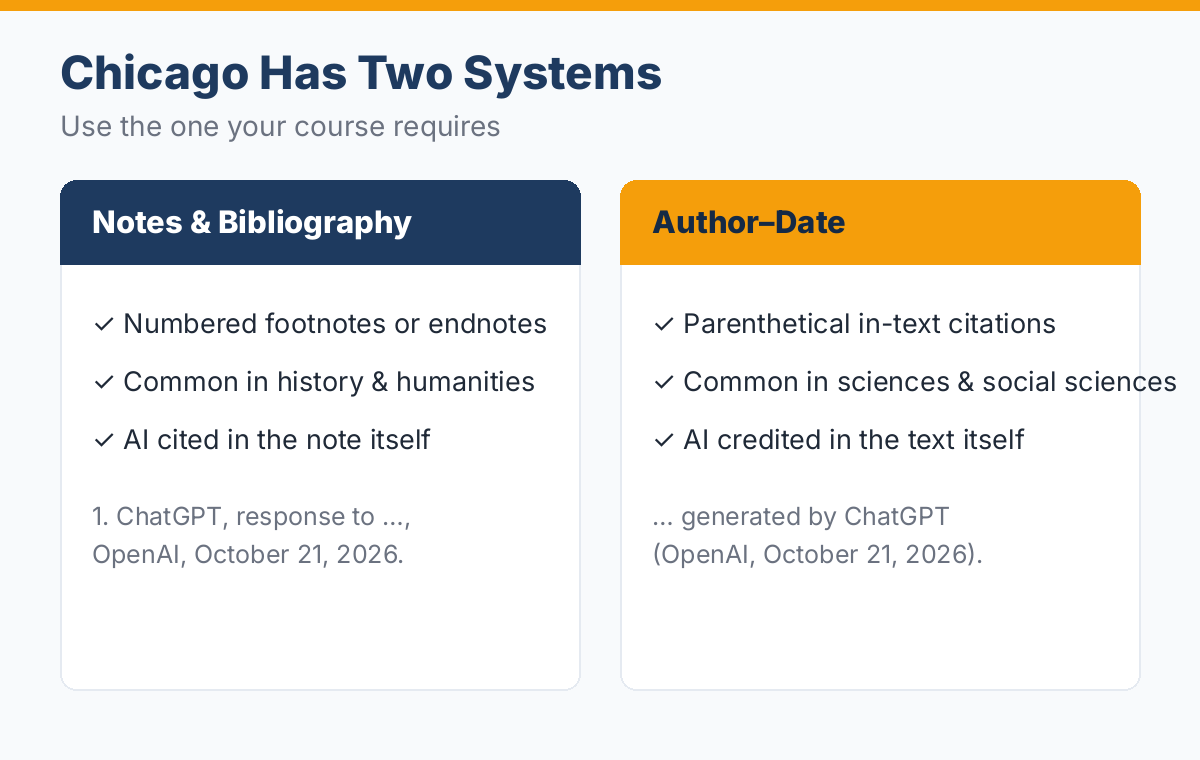
Notes and Bibliography: How to Cite AI in Chicago Style with Footnotes
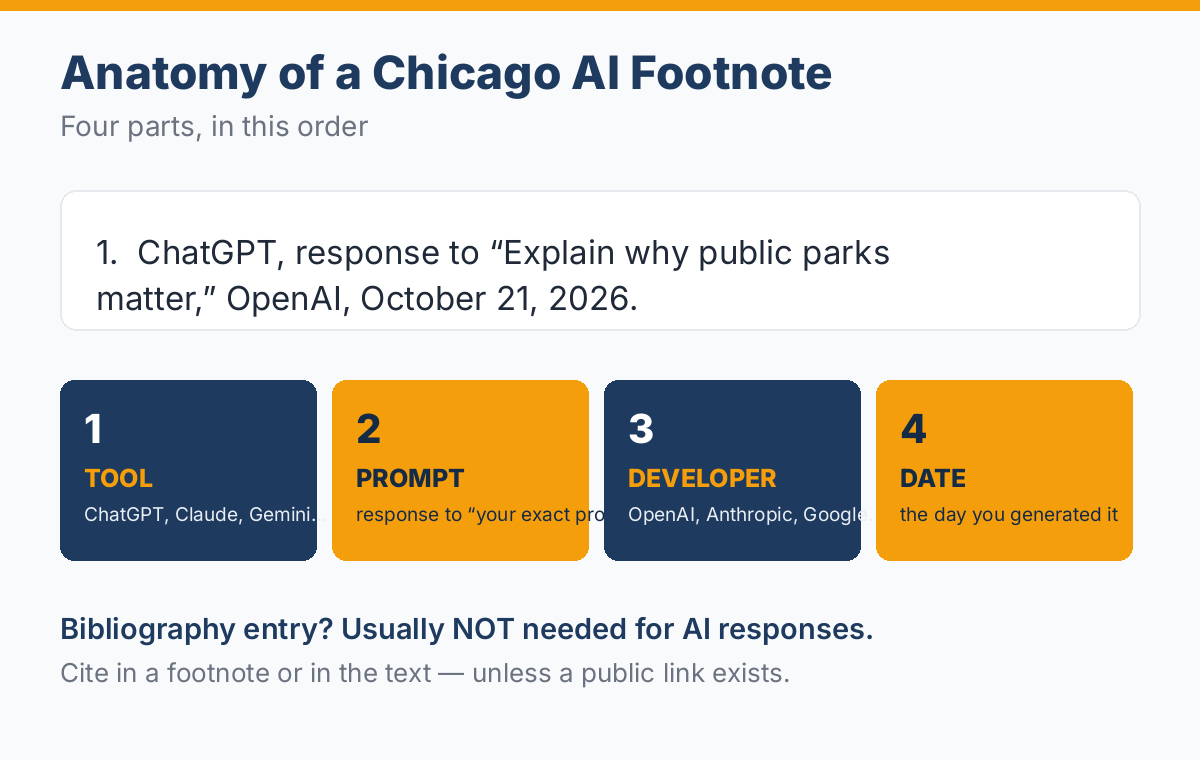
A footnote informs your reader about the source of a particular passage or thought. Chicago’s official AI guidelines give a simple pattern for the note, starting with the tool or a brief description of the text, followed by the company, date, and a common link if one is available.
| Element | What to write | Example |
| Tool name | Name the tool that made the content. | ChatGPT |
| Prompt | Include the exact question if your paper does not already show it. | Response to “Explain why rivers flood” |
| Developer | Name the company behind the tool. | OpenAI |
| Date generated | Use the day the answer was created, not the day you submit the paper. | October, 21, 2026 |
| URL | Add a working share link if you have one; never invent a link. | URL |
A first note should have enough information to identify the response. For instance,
1. ChatGPT, response to “Explain why rivers flood,” OpenAI, October 21, 2026, URL.
Later notes: If you use the same chat, your professor may be fine with a shorter note. An adapted short version would be:
2. ChatGPT, response to “Explain why rivers flood.”
The Chicago public AI answer does not give a special rule for shortened chatbot notes, so ask your instructor if they want the full note repeated. Chicago’s general note guide does allow shortening for ordinary sources.
A URL should lead to the particular conversation that you had, rather than just the company’s front page. Do not include a fake URL link to make your note look full. Save your conversation in case your professor wants to review it.
Copy-Paste Footnote Examples
The following examples use sample prompts and dates, not actual student interactions. Replace all sample details when submitting your own work. Where Chicago does not provide an exact example of a tool, the text is a clearly marked adaptation.
1. ChatGPT: Your prompt is already in the paper
Say something like, “I asked ChatGPT to explain how a public library benefits a town.” You do not need to repeat the question in your note.
- Text generated by ChatGPT, OpenAI, October 21, 2026, URL.
2. ChatGPT: Your prompt is not in the paper
If the reader cannot see what you asked, include the exact question in your note.
- ChatGPT, response to “Give three reasons people visit public libraries,” OpenAI, October 21, 2026, URL.
3. ChatGPT: You changed the generated text
Inform the reader if you made meaningful changes to the text that ChatGPT produced.
- ChatGPT, response to “Write a short paragraph about town history,” OpenAI, October 21, 2026, URL, edited for style and content.
4. Claude: text created by Anthropic’s model
The pattern for acknowledging a text generated by an AI tool is similar to the one used for Chicago’s ChatGPT, with several small differences. First, you need to mention the model’s name, then the prompt you used to generate it, and finally, the website and the date:
- Claude, response to “List ways a museum can protect old photos”, Anthropic, October 21, 2026, URL.
5. Gemini: text created by Google’s model
You can see that the pattern is almost the same except that this time it doesn’t mention the prompt:
- Gemini, response to “Explain why people kept written records”, Google, October 21, 2026, URL.
6. Image generated by AI: acknowledging the image
According to the Chicago Manual of Style, the recommended way to credit an image created by an AI is to mention the caption, the model used to generate it, the date, and the website. It should look like a credit line at the end of a section or right below the image. If you need to add a note, you can place it there as well:
- “A small library at sunset, in watercolor style”, image generated by ChatGPT, OpenAI, October 21, 2026.
However, if you are using a numbered list of figures in your paper, you may add the caption below the image as a figure credit line. Remember to state explicitly that the image was generated by an AI model.
Author–Date Format
The author–date format typically includes a name plus a year in parentheses, such as (Smith 2026). However, Chicago’s public AI Q&A doesn’t provide examples of notes for private chatbot communications. It only provides examples of notes. This distinction is important; you should not apply a rule for fictional formats to a real tool.
The easiest way to cite a private AI response is often to include the tool’s name and the date within the text of your sentence:
In-text example: On October 21, 2026, ChatGPT (OpenAI) provided me with three recommendations for improving the library’s study space.
If your instructor prefers parentheses, you can adapt Chicago’s treatment of personal messages:
Adapted in-text example: (ChatGPT, response to the author, October 21, 2026)
This is an adaptation, not an AI-specific example presented in Chicago’s public guide. It works only if your instructor approves that approach.
What about (ChatGPT 2026)? This is the format of a standard author-date citation. You should use a form like this only if your course asks you to respond to a publicly accessible shared chat as a listed source. Here’s an example of an adapted pair:
Adapted in-text citation: (ChatGPT 2026)
Adapted reference list entry: ChatGPT. 2026. “Response to ‘Why do cities protect old buildings?’” OpenAI, October 21. [Public shared chat URL].
No Chicago AI-specific reference entry is provided in the official public Q&A. Replace the bracketed text with a working link and seek your instructor’s permission prior to utilizing this exception. For chats held in private, a descriptive statement within the text is typically more straightforward and less evasive.
Bibliography Rules: When AI Entries Do (and Don’t) Appear
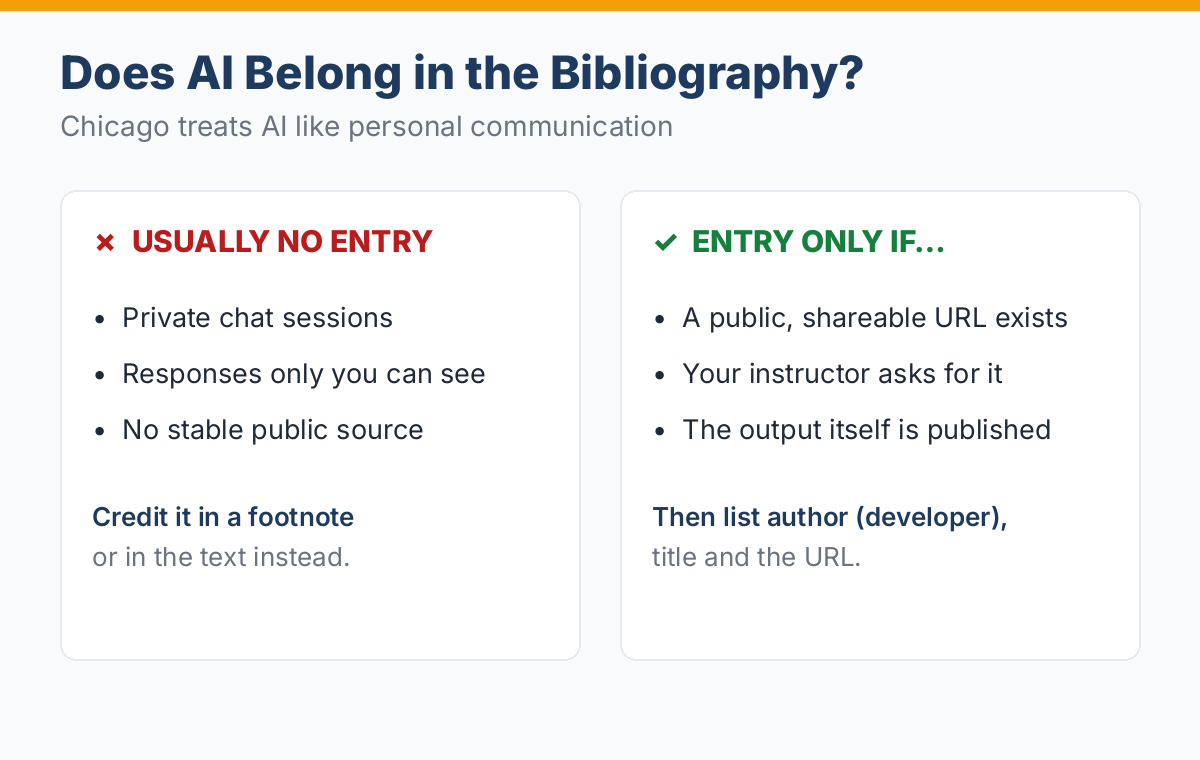
A bibliography is a list of sources at the end of a paper. A private chatbot answer is different. Other people usually cannot access your private chat and see the same answer. This is why you normally cite the output in your text or note rather than a standard bibliography entry.
Default rule: No AI bibliography entry for a private chat. You may still need a note where the content appears. Your school’s requirements may necessitate more detailed information.
Possible exception: Public shared conversation. If you have a link that your readers can follow, your professor might ask you to provide one, but the official Chicago QA does not include a required bibliography format for a shared chat. Do not make up a template and present it as an official Chicago standard.
If your instructor asks for it, you could use an instructor-approved variation of the following:
ChatGPT. “Response to ‘Why do cities protect old buildings?’” OpenAI, October 21, 2026. [Public shared chat URL].
This is an adapted example of Chicago’s default bibliography style for AI. Ensure the link is active, the date corresponds to the current session, and the wording describes the content you used.
A final note is that the bibliography entry should not replace your responsibility to verify facts. If you are presented with a statement by AI about history, health, law, or science, find a reliable original source. Cite that source when you use its information.
5 Common Mistakes Students Make
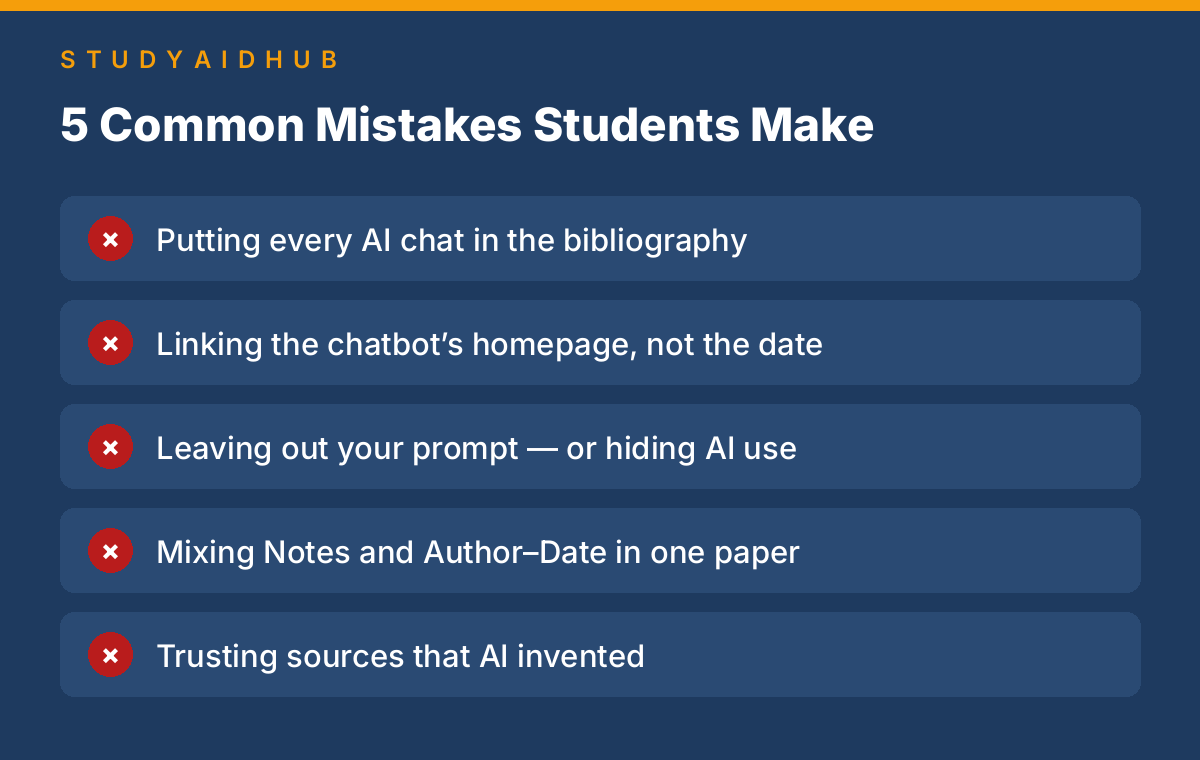 1. Including each chatbot talk in the bibliography: A private AI response is not the same as a book that everyone can see. Chicago allows for a credit in your writing or a note to the reader. Do not include each private chat entry unless your professor asks you to do so.
2. Using the company site instead of the generation date: A link to a chatbot’s homepage will not tell what it said to you. Please record the day that you received the reply and include a specific shared conversation link if you have one. Also, name the developer, such as OpenAI, Anthropic, or Google.
3. Leaving out prompts or hiding use of AI: A brief text generated by an AI can vary considerably in content depending on the precise prompt used to generate it. If your prompt is not visible in your paper, be sure to include it in your footnote. If the AI provided help beyond just supplying quotations, you should explain what help it gave you, according to your course’s policy.
4. Mixing the two Chicago formats: Your paper should generally stick to one or the other system of notes and bibliography. Don’t use numbered notes for some entries and author-date parentheticals for others, unless your instructor says otherwise. You might want to ask your teacher to see an example paper to get a better idea of how to proceed.
5. Trusting sources that AI invents: Sometimes, AI may come up with the wrong date, quotation, or reference. Open the books, studies, or web pages listed as sources and verify the information. If not, you cannot use this evidence. Giving credit to one’s bot does not ensure that it will present correct data.
Frequently Asked Questions
1. Do I include AI citations in my Chicago bibliography?
Generally no, unless you are citing a private AI response, in which case you give credit in the text or a note. The reason for the default is simple. Your reader may not be able to access the same conversation. A professor might make an exception for a publicly shared link or want a separate statement about your use of the AI; follow their instructions if they differ from this advice.
2. Do I have to include my prompt in the citation?
Include the prompt when your paper does not already clearly state what you asked. If you have already stated your question fully in the text of your paper, you can use a shorter note. Keep the original wording of the prompt rather than paraphrasing it afterwards.
3. How do I cite AI output that I edited?
Credit the tool and note that you edited it. The Chicago Manual of Style recommends using simple language, such as “edited for style and content,” in the note or text itself. This is if you have made substantive changes to the text. It does not apply if you have simply changed the font or quotation marks.
4. Which Chicago system should I use to cite AI — footnotes or author–date?
Use the system your course requires. Humanities courses usually use Notes and Bibliography, so the AI citation goes in a footnote; sciences and social sciences often use Author–Date, where you credit the tool in the text with the developer and date in parentheses. This guide shows both formats.
5. Do I need to include the date I used the AI tool?
Yes. Chicago style treats an AI response like a dated communication, so the footnote or in-text credit includes the day, month and year you generated the response — for example, October 21, 2026. If you use the same tool on different days, cite each date separately.
Final Words:
When using AI in your paper, be sure to note the source, the creator of the AI model, the date, and the prompt if necessary. You can use a footnote, or you can simply put it in your writing itself. Also, you wouldn’t include an entry for an AI source in a bibliography. Make sure you double-check your work and save the chat somewhere. Always remember to abide by your professor’s guidelines and any additional instructions they may give you.
✍️ About the StudyAidHub Team
The StudyAidHub team hands-on tests AI tools for students — every guide is based on real testing and verified against official sources, so you get advice you can actually trust. Learn more about how we test →
Citation formats last verified against the official Chicago Manual of Style guidance: October 23, 2026. Current source edition: 18th (2024).