How to Cite ChatGPT in MLA Format – 9th Edition
In this digital world, many students usually depend on ChatGPT to understand difficult subjects, brainstorm essay topics, and improve their writing skills. However, when you are using AI for academic writing, you must reference AI content accurately and justify your usage. This can be difficult for you because many learners haven’t used AI before.
This article will explain how to cite ChatGPT in MLA format in a simple manner with examples. By reading this piece, you will find out how to create Works Cited citations, format in-text citations, and incorporate AI into your assignment.
The guidelines comply with MLA standards for the ninth edition of the style guide. It’s important to note that AI tools can update, and thus it’s critical to always indicate the name of the model and when the conversation took place before submitting the assignment.
⚠️ Academic integrity note: Correctly citing AI does not mean it is okay to use AI without acknowledging it. Always check your university and professor’s policy on AI usage — some courses ban AI tools completely, no matter how accurately they are cited.
Also, read our recent student guide on How to Cite AI in APA Format with Examples.
How Do You Cite ChatGPT in MLA?
To cite ChatGPT in the MLA format, the content you created must be followed by ChatGPT named as a tool giving details about the model used, the name of the publisher of ChatGPT, when the content was generated and finally mention, if available link to the conversation that took place.
General template:
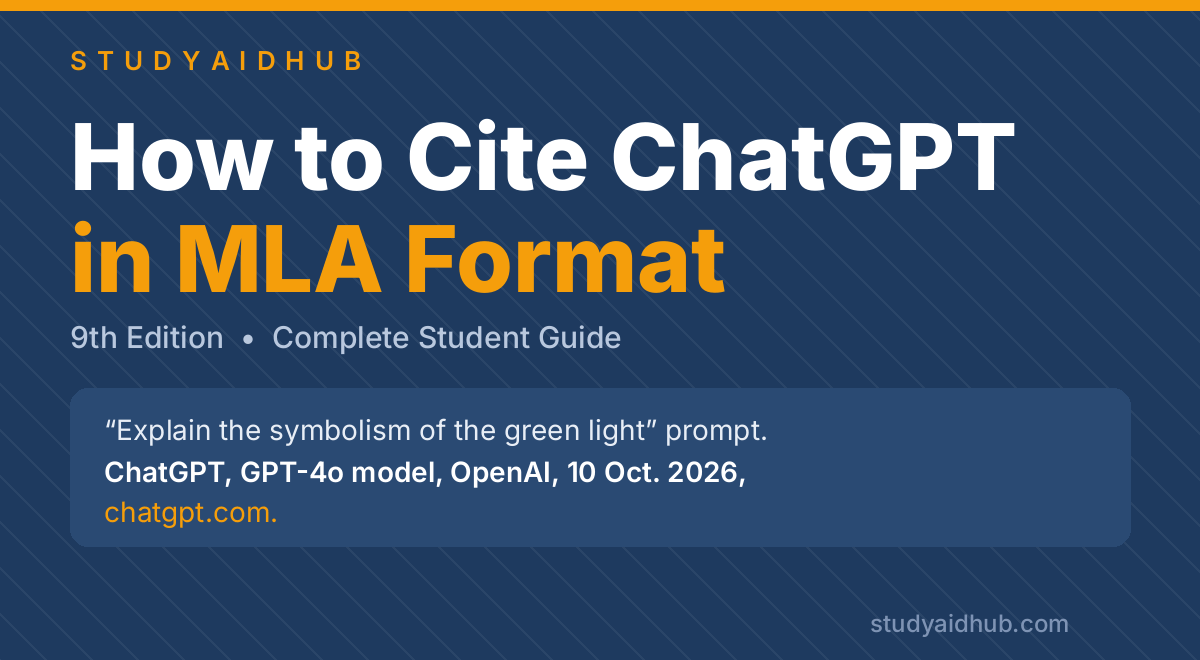
“Description of your prompt” prompt. ChatGPT, model [model name], OpenAI, [day Month year], [shareable conversation URL].
Example:
“Explain the symbolism of the green light in The Great Gatsby” prompt. ChatGPT, model [model name], OpenAI, 10 Oct. 2026, [conversation URL].
In-text citation: (“Explain the symbolism”)
Replace the example details with information from your own generated conversation. This specific format follows the recent MLA guidelines in which the material must mention a certain model name and a stable, shareable link as far as possible.
The MLA Works-Cited Format for ChatGPT — Element by Element
Knowing every single part makes the MLA citation process much easier for you. The Works Cited entry helps readers understand what you used and, when possible, find the original AI response.
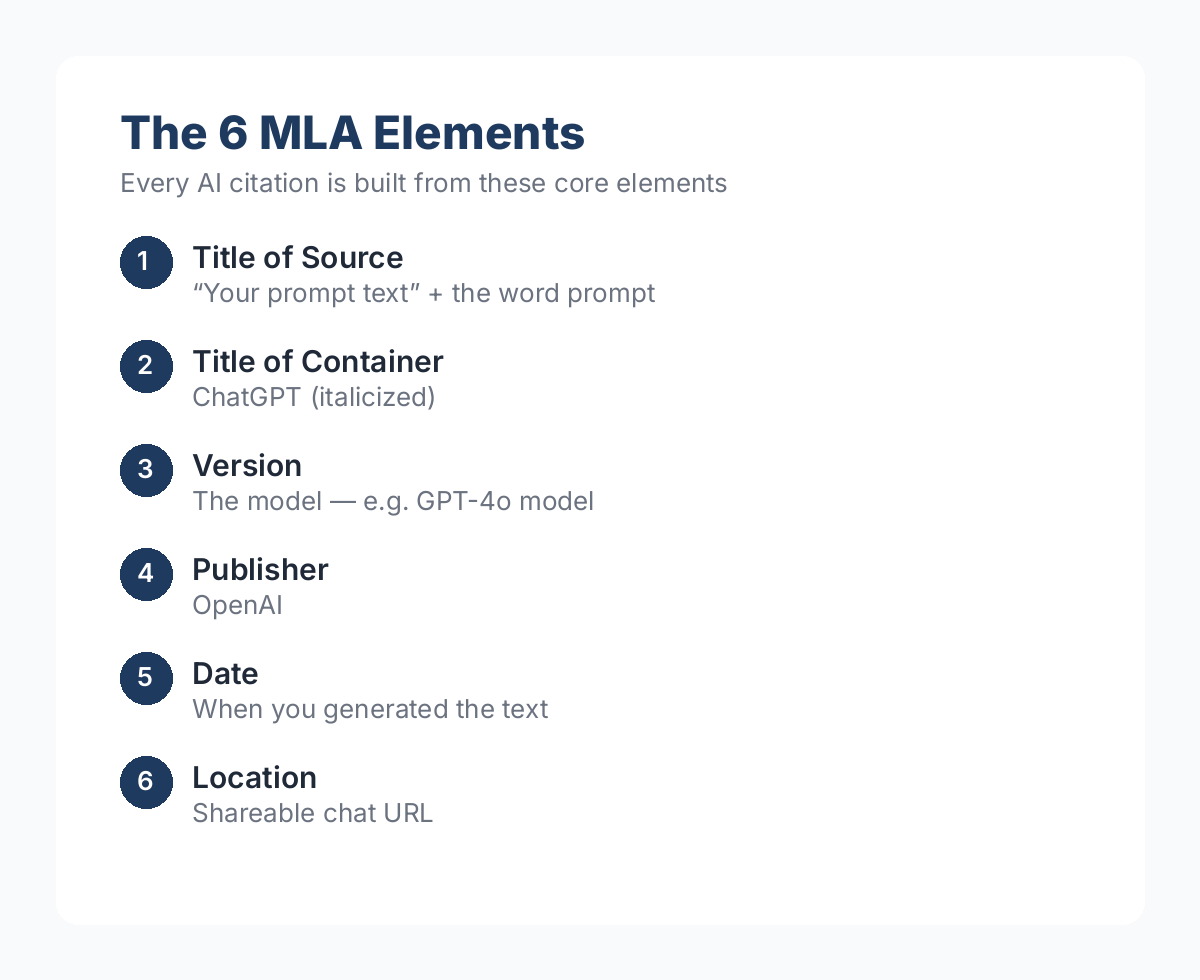
| Element | What to write | Examples |
| Title of source | Describe your prompt or the content generated. Use quotation marks around the description. | “Explain photosynthesis” prompt |
| Title of container | Write the tool’s name in italics. | ChatGPT |
| Version | Include the model name or number shown in the tool. | model [model name] |
| Publisher | Name the company that made the tool. | OpenAI |
| Date | Give the date the answer was generated. | 10 Oct. 2026 |
| Location | Add the stable, shareable conversation URL when available. | [conversation URL] |
In the first part, you include the actions of the tool as requested. The next part contains the name and model of the tool. In the end, the publisher and date inform about who answered the query and when.
For the purpose of the last part, use the shareable link if the tool provides it. If there’s no permanent link available, you can simply refer to the general link of the AI tool according to the MLA Style Center.
Avoid any presumptions about model names, date of generation, or conversation links. Be sure to check the actual conversation before submitting your work.
How to Cite ChatGPT in MLA Format: Copy-Paste MLA Citation Examples
Here are some examples showing the way to cite several types of prompts used in ChatGPT. In the examples listed below, you can see that the AI model’s name and URL given are just placeholders. That is why it is quite important to put your information in place of them before citing them in your work.
Example 1: A Short Prompt
Suppose you asked ChatGPT to explain photosynthesis for a biology assignment.
Works Cited entry:
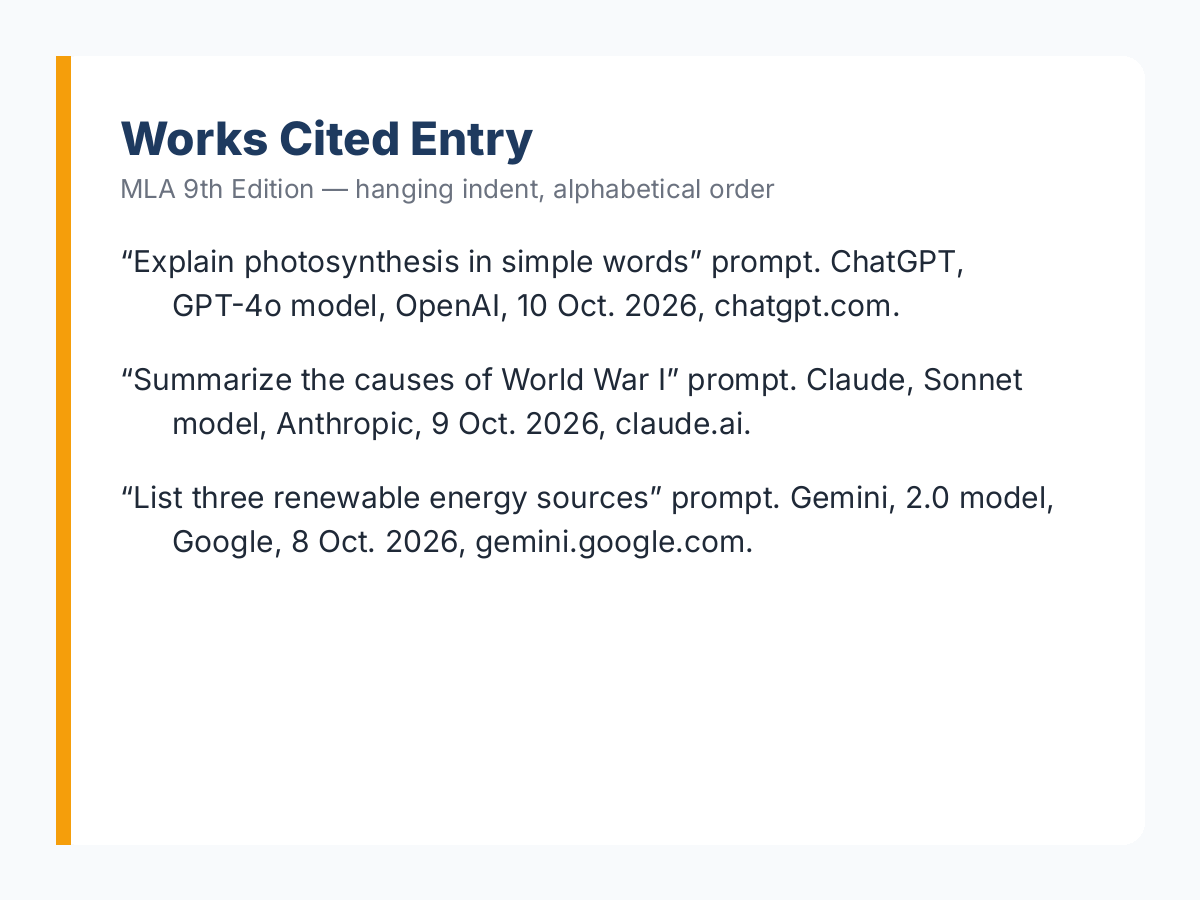
“Explain photosynthesis in simple words” prompt. ChatGPT, model [model name], OpenAI, [day Month year], [conversation URL].
In-text citation:
(“Explain photosynthesis”)
Use this entry when citing information provided in the generated explanation in your assignment work. If the answer is just used as a means of understanding the subject, check if you are required to include any citation or acknowledgement of the source.
Example 2: A Long Prompt
You could ask a question with a long query. However, you do not have to repeat the complete text as a quotation; instead, you can use a more concise description that accurately represents the essence of the text.
Original prompt: Explain the causes of climate change, describe its effects on poor communities, and suggest three affordable ways people can reduce their carbon footprint.
Works Cited entry:
“Explain the causes and effects of climate change” prompt. ChatGPT, model [model name], OpenAI, [day Month year], [conversation URL].
In-text citation:
(“Explain the causes and effects”)
The shortened description should assist readers in recognizing the response you used. It is always advisable to keep sufficient data to make the entry clear and accurate.
Example 3: A Follow-Up Prompt
Imagine that you first question asked for the conclusion of a book. You then asked ChatGPT to briefly describe the key character’s choices in more detail.
If you utilize content from the follow-up answer, describe that particular request.
Works Cited entry:
“Explain the main character’s choices” follow-up prompt. ChatGPT, model [model name], OpenAI, [day Month year], [conversation URL].
In-text citation:
(“Explain the main character’s choices”)
If you use data from two distinct prompts, then it is necessary to make separate entries when needed. This helps your readers understand which response supports each part of your paper.
Citing Claude and Gemini in MLA
For other generative AI tools, this same basic approach can be used. Replace the AI tool name and author, and verify the model name and shareable URL.
Claude example:
“Explain the water cycle” prompt. Claude, model [model name], Anthropic, [day Month year], [conversation URL].
Gemini example:
“Explain the water cycle” prompt. Gemini, model [model name], Google, [day Month year], [conversation URL].
In-Text Citations — With Examples
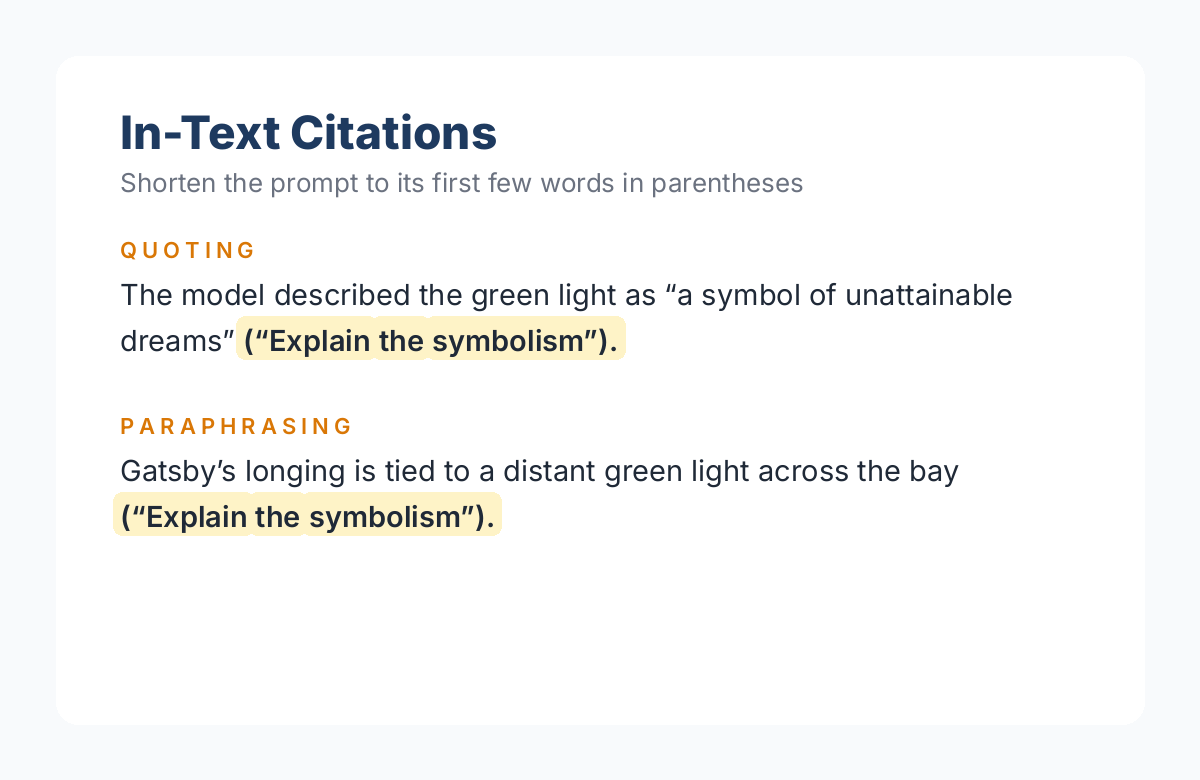
In-text citations are used to indicate which source is the intended source of your paragraph’s information. When using the MLA method for AI-generated content, it is important to use a shortened description of the prompt in parentheses.
General Example:
ChatGPT described that the water cycle adds evaporation, condensation, and precipitation (“Describe the water cycle”)
The citation points readers to the matching entry in your Works Cited list. Make sure that the description in the parentheses matches the beginning of the accurate entry.
What If Your Prompt Is Very Long?
You can convert a lengthy piece of writing into a few significant words; thus, you may find a phrase that summarizes your work accurately.
For example, when your writing requires to refer to the causes, effects and how to overcome air pollution, you might come up with an in-text citation such as “Discussing air pollution.”
A phrase that doesn’t relate to many entries should be avoided.
What If You Use Multiple Prompts in One Chat?
One conversation may contain multiple questions and answers. When using material from different prompts, explain the specific response related to each prompt and make separate entries for each answer.
For example, one entry can focus on the prompt involving the causes of pollution while another entry can elaborate on a subsequent prompt involving solutions. Be sure to use proper in-text citations for any claim made.
How to Describe AI Use in Your Paper?
The Works Cited entry may not encompass the entire picture of how AI was used. Depending on your assignment, you may need to provide a description of your use in a short note or some appropriate location.
In the Method Section
In the methodology section for research papers, discuss which AI tool you used and, if applicable, what its model is and how the tool was used.
Example:
“ChatGPT was used to assist in organizing early research questions and describe key terms. All factual claims and supporting sources were checked independently.”
Only use this statement if it accurately describes your work.
In the Introduction
For an essay, you may briefly state that you used AI and explain the purpose.
Example:
“ChatGPT was used to generate initial ideas for this essay. The final argument and supporting evidence were reviewed and developed by the student.”
Follow your college or university teacher’s instructions about where to put this information.
In an Appendix or Notes
It is good to keep a copy of the conversation just in case your professor would like to check it out. Remember that someone who does not have access to your private chat will not be able to read it, and the general link may not show the exact text you have written.
A saved copy of the conversation, screenshots, or a shareable link can be useful as evidence. Before sharing anything, make sure you follow your institution’s privacy rules and do not reveal any confidential information.
Six Common Mistakes Students Make
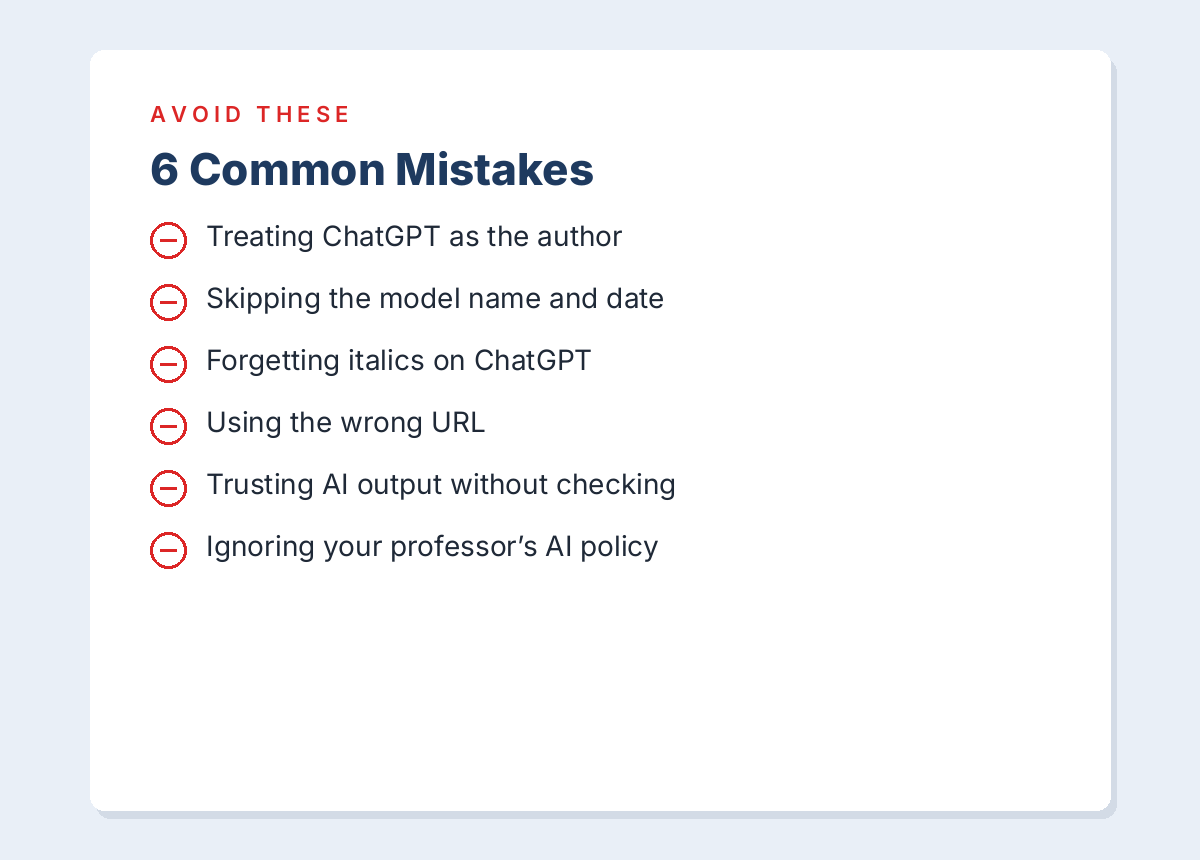
Here are some of the most common mistakes that students generally make while preparing an assignment or thesis.
Naming ChatGPT the creator
According to the MLA Style Center, you should not identify an AI tool as the creator. You need to begin with a description of the prompt.
Missing the model and the date of creation
AI tools use different models. You must name the model you are using and include the date when you got the response. Do not make up for the missing information.
Not using italics for ChatGPT
Use italics for the name of the tool, which serves as the title of the container in the Works Cited list.
The use of an incorrect URL
Whenever possible, use a stable, shareable link. If the AI tool doesn’t give one, use the general URL instead of creating a non-related one.
Believing in the information provided by a chatbot
You have to remember that chatbots may provide wrong information, make up unreliable references, and offer incomplete explanations. Verify authentic sources on your own and refer to them if they help you support your idea.
Ignoring the AI policy established by your professor
Some courses ban or severely limit the use of AI technologies. These tools might have been cited accurately, but you still need to check all relevant regulations before using a chatbot in your coursework.
Citation formats last verified against the MLA Style Center official guidance: October 11, 2026.
Frequently Asked Questions:
What if my prompt was very long?
You can use a short description that clearly defines what the answer is. You need to choose a description that gives enough information for your audience to relate it to the right entry.
What if my professor bans AI tools completely?
It is important that you do not use AI tools for the assignment unless your instructor tells you to do so. Even if you add a citation, this does not exempt you from the prohibition of the use of AI in your course.
Is citing Claude or Gemini in MLA different from ChatGPT?
The main process is almost the same but the tool name, publisher, model, time of the usage, and chat link will be different. Make sure that you have the information specific for the tool that you used.
Do I need to save or share my ChatGPT transcript?
It is recommended that you save your work because this allows you to verify the specific answer and keep a record of your work. You should only share this information when necessary or if permitted to do so according to your school’s policies regarding privacy.
What if I can’t get a shareable link for my ChatGPT conversation?
If ChatGPT doesn’t give you a share link, use the tool’s general URL instead — for example, chatgpt.com. The MLA Style Center says to give a stable, shareable URL when one exists, and the general tool URL when it doesn’t. Everything else in the citation stays the same.
Final Words
When looking to cite in MLA style, remember to gather the necessary information and understand where to look for it. Give a brief description of either a prompt or the produced piece, state which tool or model was used, document when the text was produced, and paste the link as appropriate.
Maintain all records and verify your resources and any facts included in your work. Last but not least, take note of your professor’s policy regarding the use of AI before using it for any assignment.
✍️ About the StudyAidHub Team
The StudyAidHub team hands-on tests AI tools for students — every guide is based on real testing and verified against official sources, so you get advice you can actually trust. Learn more about how we test →