How to Cite AI in APA Format with Examples – A Complete Student Guide
If you are writing an assignment with the help of ChatGPT, Claude, Gemini, or Perplexity, you may need to explain and cite that use. The good news is, learning how to cite AI in APA format is relatively easy once you know whether you are citing a specific AI chat or AI tool in general.
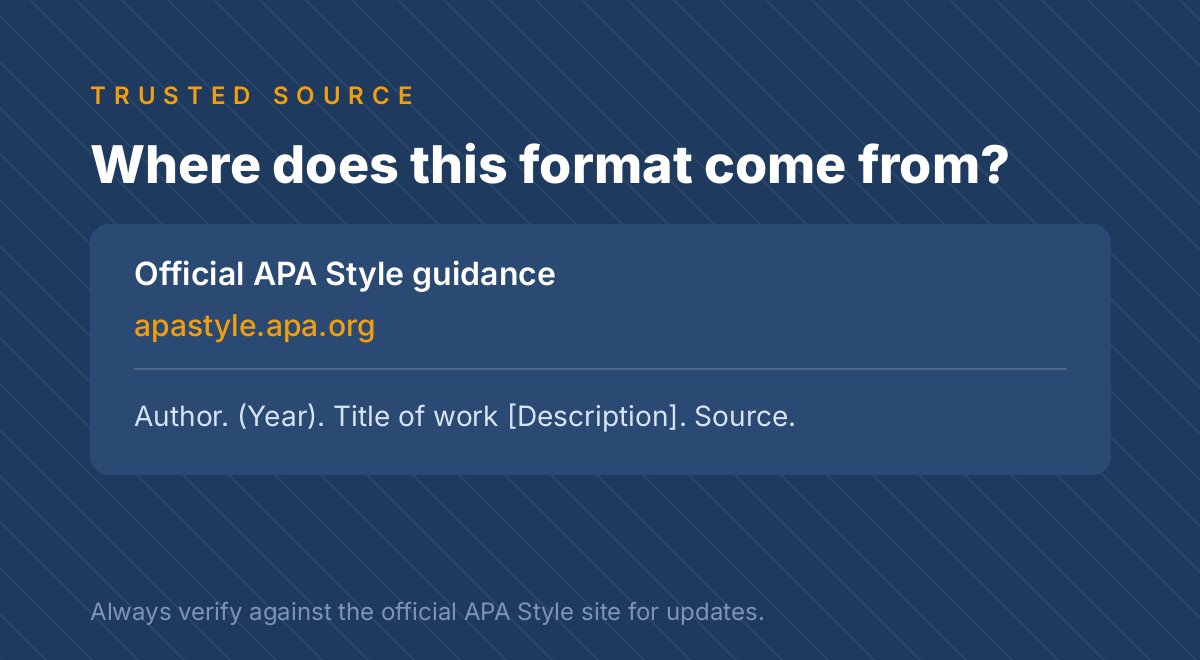
APA’s official guide (7th edition) covers both reference types. Below, you’ll find copy-paste templates, real examples, and answers to common points of confusion.
⚠️ Academic integrity note: Correctly citing AI does not make using AI inappropriately acceptable. Always check the AI policy of your course, professor, and university first — some courses prohibit AI tools entirely.
How to Cite AI in APA Format
For a specific, shareable AI chat, APA uses this structure:
AI Company Name. (Year, Month, Day). Title of chat [Generative AI chat]. Tool Name/Model. URL
Example:
OpenAI. (2026, October 6). High school grammar concepts [Generative AI chat]. ChatGPT. https://chatgpt.com/share/your-chat-link
In-text citation:
(OpenAI, 2026)
If you are writing about the AI tool in general rather than a particular conversation, cite the company behind it, the year of the version you used, the tool’s name, a bracketed description, and the tool’s main URL.
The APA Reference Format for AI – Element by Element
In APA style, the AI’s creator is the author. For a specific conversation, include the chat’s date and title, plus the tool name and a link to the chat itself.
| Element | What to write | Example |
| Author | Company that created the AI tool | OpenAI |
| Date | Full date for a chat; year for the general tool | (2026, October 6) |
| Title | Chat title | Study plan for final exams |
| Bracket description | Description of the source | [Generative AI chat] |
| Source | Tool/model plus share URL, or main tool URL | ChatGPT + URL |
Author
The author of the tool should be the organization that has developed the tool. For example: OpenAI for ChatGPT; Anthropic for Claude; Google for Gemini; Perplexity AI for Perplexity.
Date
For a specific AI conversation, use the full date — year, month, and day — of when the chat took place.
For a general reference to the AI tool, use the year in which the tool was first launched.
Title
For a specific chat, use the conversation’s title. For a general tool reference, use the model name in italics, followed by the version in parentheses.
Bracketed description
The bracketed description tells the reader what kind of AI tool it is — for chatbots like ChatGPT, use [Large language model].
Source
For a specific conversation, include the model name and the chat’s shareable URL. For a general tool reference, just use the tool’s main URL. Since the company is already named as the author, don’t repeat it as the publisher.
Copy-Paste APA Citation Examples for AI (4 Tools)
Always name the exact tool or model you used. AI platforms update frequently, and some offer different models depending on your plan or selected mode.
Don’t copy a model version from someone else’s citation — cite only the version you actually used.
1. ChatGPT (OpenAI)
General tool reference:
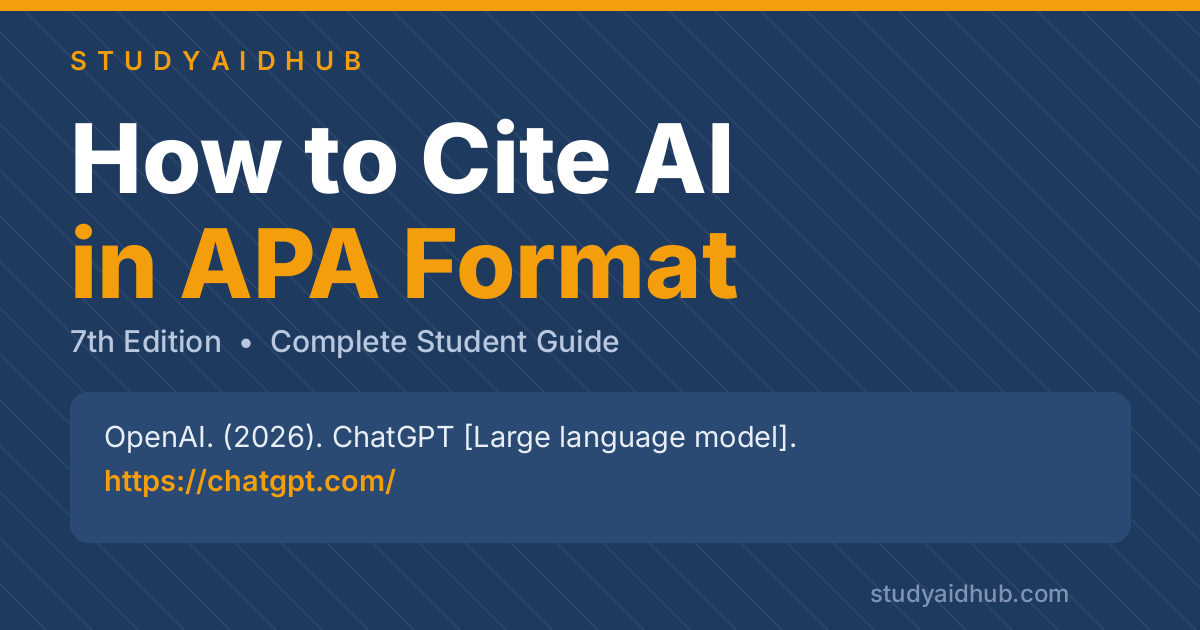
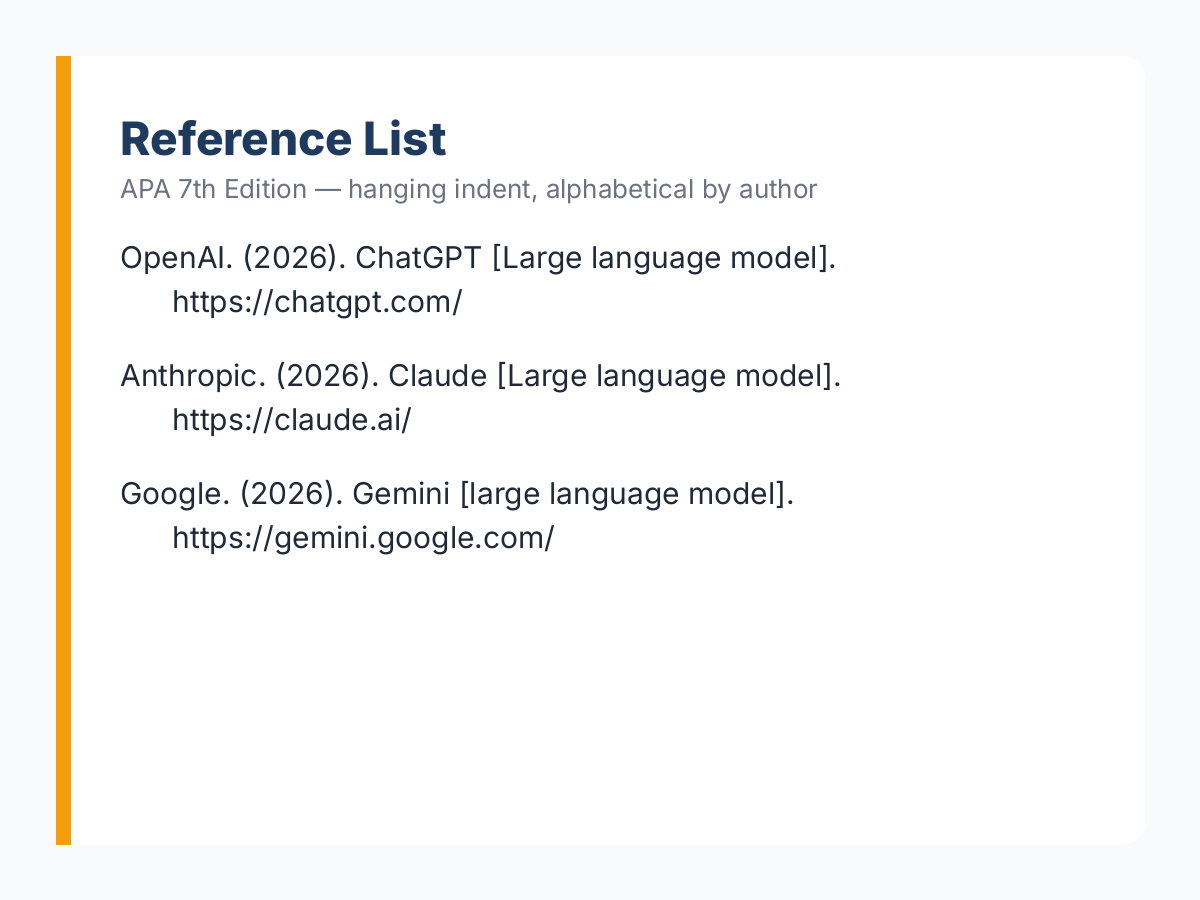
OpenAI. (2026). ChatGPT [Large language model]. https://chatgpt.com/
In-text citation:
(OpenAI, 2026)
ChatGPT offers different models depending on your plan. When citing a specific model, use the exact name shown in your interface.
2. Claude (Anthropic)
General tool reference:
Anthropic. (2026). Claude [Large language model]. https://claude.ai/
In-text citation:
(Anthropic, 2026)
When referring to a Claude model, be sure to mention the exact name instead of assuming. Anthropic continues to release various models from the Claude family.
3. Gemini (Google)
General tool information:
Google. (2026). Gemini [Large language model]. https://gemini.google.com/
In-text citation:
(Google, 2026).
Gemini has different model variants — always cite the exact model shown in your session rather than assuming one.
4. Perplexity AI
General tool reference:
Perplexity AI. (2026). Perplexity [Generative AI tool]. https://www.perplexity.ai/
In-text citation:
(Perplexity AI, 2026).
Perplexity offers different AI models and experiences, so always cite the model shown in your own session instead of assuming a version.
Citation formats last verified against APA Style official guidance: October 8, 2026.
In-Text Citations — With Examples
In parenthetical format, use the company name and year at the end of the sentence: The generated explanation described spaced practice as more effective than cramming (OpenAI, 2026).
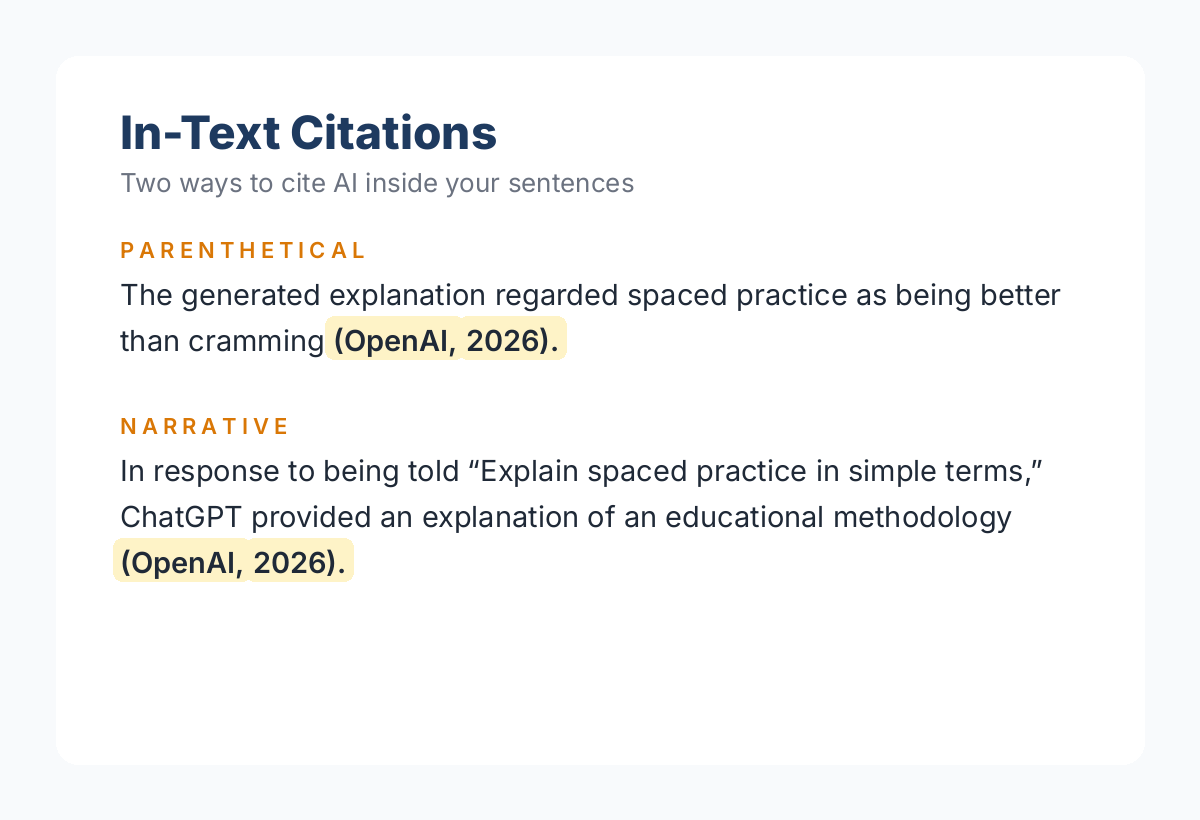
In narrative format, weave the company into your sentence: When asked to “explain spaced practice in simple terms,” ChatGPT described an approach where studying is spread across multiple sessions (OpenAI, 2026).
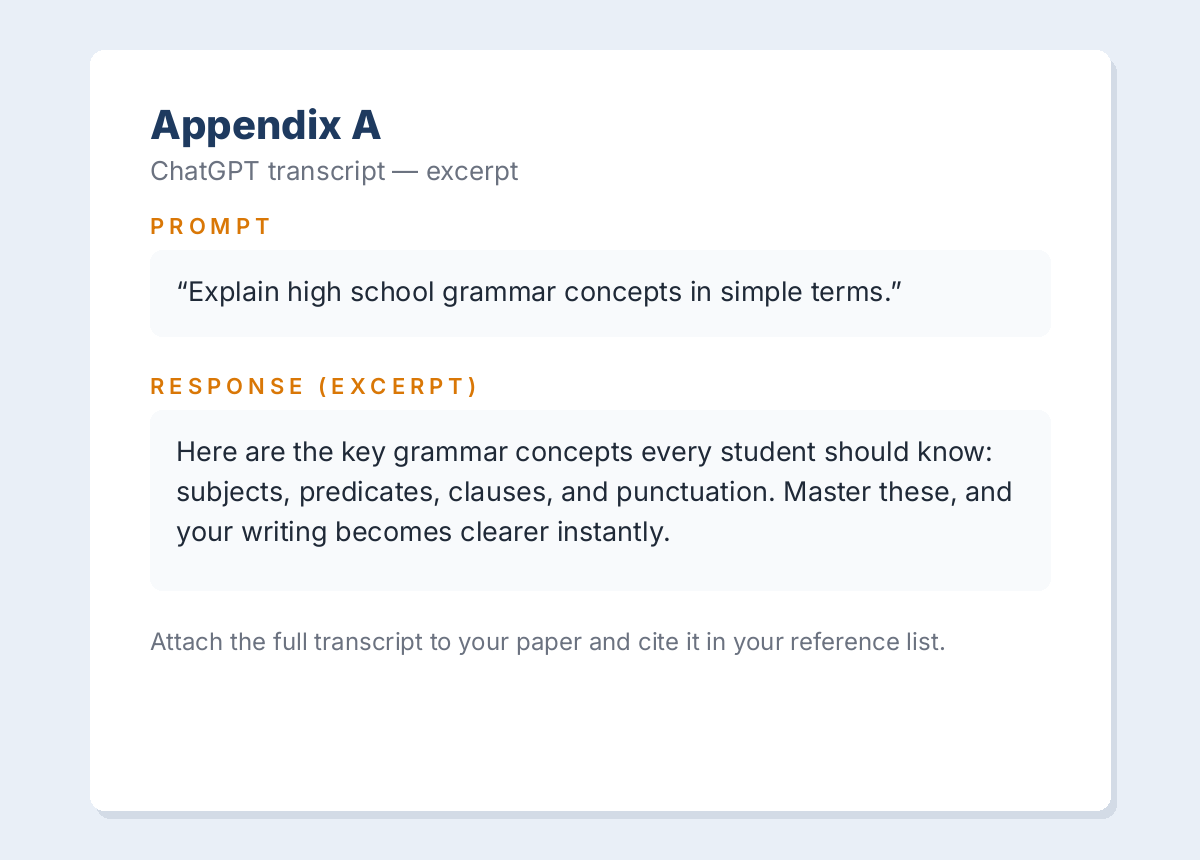
If your exact prompt wording matters, quote or describe it in your paper’s text. The prompt belongs in your description of how you used the tool — never in the author field of the reference entry.
If you quote a passage produced by an AI, you need to specify that it is an AI-generated response. However, it is extremely important to validate all statements using information taken from reputable sources.
AI Chat vs. AI Tool — APA’s Two Reference Types
Understanding the difference between an AI chat reference and an AI tool reference matters. Use a specific chat reference when the conversation itself is important for your paper and you can identify it — include the date, chat title, description, tool or model, and a shareable URL when available.
Use a general tool reference when discussing the software itself without pointing to a specific conversation. That format uses the company name, version year, tool or model name, bracketed description, and main URL. This distinction matters because older APA guidance treated ChatGPT mainly as software, while the latest update adds a format for citing specific AI conversations too.
How to Describe AI Use in Your Paper
If you used AI in your work, explain which tool you used, how you used it, and what you did with the results.
- In the Methods section of the research paper, you can provide an explanation of the tool, its function, and the required prompts/settings.
- You may explain how the AI tool helped you to come up with search words, summarize the information for comparison, or offer suggestions or revisions.
- In case you are writing an essay, you may describe how AI contributed to your work in the introduction or in any other relevant section of the paper.
- If you decided to quote or paraphrase AI-generated material, make sure to properly cite it in your text.
If the reader does not have access to the chat itself, save the prompt and the results provided. This can be done with an appendix or additional file.
5 Common Mistakes Students Generally Make
- Using ChatGPT as the author: In the APA referencing style, the company that created the AI model is used instead of the AI title for the author. OpenAI is the author for ChatGPT, Anthropic for Claude, and Google for Gemini.
- Making up the model version: AI platforms undergo constant updates and may change models for different users, so if you cannot see the model version, you shouldn’t make up a version; use the tool title.
- Using AI-generated information without verifying it: Information created by AI could be wrong or made up. It is better to read the original source if the information is based on the article, book, report, or dataset.
- Considering AI content as personal communication: AI-generated content does not qualify as communication between individuals. APA gives different formats for citing AI sources in a paper.
- Failure to follow the AI guidelines of the university or professor: Correct referencing does not make using AI right automatically. There are certain classes where the use of AI is permitted, while there are others that prohibit the use; check if it is allowed before using it.
Frequently Asked Questions:
1. Is citation needed when ChatGPT has just been used for grammar corrections?
Grammar and proofreading help generally doesn’t need a citation. But if ChatGPT generated original content or paraphrased your writing, check your professor’s AI policy — you’ll likely need to cite it.
2. What should I do if my professor forbids using AI tools?
If your teacher prohibits you from using AI applications for a specific assignment, you must not use it. Even if you add a reference, according to your professor’s policy, it is still unacceptable to use AI.
3. How to reference an AI-created image in APA style?
When using an AI-generated image, state which tool created it and clearly label it as AI-generated.
4. Is the citation of ChatGPT different from Claude and Gemini?
The APA citation structure is the same for all AI tools — only the organization name changes. ChatGPT is by OpenAI, Claude by Anthropic, and Gemini by Google, so make sure you credit the correct company.
5. What happens if I do not know the version of the AI model?
If you don’t know the exact version, don’t guess. Use whatever identifies the model in your interface — it’s better to omit unclear details than to include wrong ones.
Final Words:
Citing AI in APA style is straightforward once you know the format. The key is to name the right company, verify the tool and version details, and follow your assignment’s instructions. Always cross-check AI-provided information against reliable sources before using it in your paper. When in doubt, keep a record of your prompts, the AI’s replies, and your sources.
✍️ About the StudyAidHub Team
The StudyAidHub team hands-on tests AI tools for students — every guide is based on real testing and verified against official sources, so you get advice you can actually trust. Learn more about how we test →